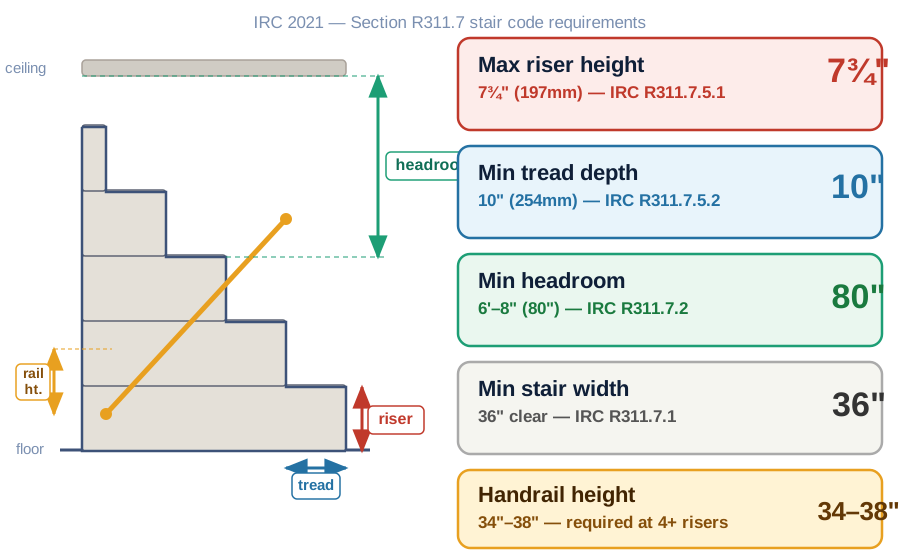
A staircase that fails building code inspection is more than an inconvenience — it can halt a project, require expensive rework, and in the worst cases, create a genuine fall hazard. IRC 2021 Section R311.7 sets precise requirements for every stair dimension, and each requirement exists for a specific safety reason.
This guide covers every measurement you need to know, with the exact IRC numbers and an explanation of why each rule exists.
Check your stair dimensions now
Enter your riser height, tread depth, headroom, and handrail height for an instant code check.
Use the free stair calculator →The complete IRC stair code requirements
| Measurement | IRC 2021 limit | Code section |
|---|---|---|
| Maximum riser height | 7¾" (197mm) | R311.7.5.1 |
| Minimum tread depth | 10" (254mm) | R311.7.5.2 |
| Riser uniformity (max variation) | ⅜" between largest & smallest | R311.7.5.1 |
| Minimum headroom | 6'–8" (80" / 2032mm) | R311.7.2 |
| Minimum stair width | 36" clear | R311.7.1 |
| Handrail height range | 34"–38" above nosing | R311.7.8 |
| Handrail required when | 4 or more risers | R311.7.8 |
| Nosing projection | ¾"–1¼" (where nosing present) | R311.7.5.3 |
Riser height: maximum 7¾ inches
The riser is the vertical face of each step — the height you lift your foot when climbing. IRC caps this at 7¾ inches. Taller risers force people to lift their legs higher with each step, increasing fatigue and fall risk, particularly when descending.
There is no minimum riser height in IRC (open risers are permitted in some cases), but all risers in a single flight must be within ⅜ inch of each other. This uniformity rule is critical: the human body unconsciously adapts to the rhythm of a staircase after the first step. An unexpected change in riser height — even a half inch — is one of the most common causes of stair falls.
Tread depth: minimum 10 inches
The tread is the horizontal surface you step on. IRC requires a minimum depth of 10 inches, measured from nosing to nosing (the front edge of one tread to the front edge of the next). Shallower treads force you to step on the balls of your feet, destabilizing your balance — especially while descending.
The 10-inch minimum is an absolute floor. Many builders use 10½ to 11 inches for interior stairs, which feels more comfortable and reduces the stair angle. For exterior and deck stairs, 11 inches is common because people tend to descend more cautiously outdoors and expect a more gradual slope.
The 2R + T comfort formula
Beyond code compliance, a useful rule of thumb for stair comfort is the Blondel formula: 2 × rise + run = 24–25 inches. A 7-inch riser with an 11-inch tread gives 2(7) + 11 = 25 — right in the sweet spot. This keeps the stair angle in the comfortable 30°–35° range.
Headroom: minimum 6 feet 8 inches
IRC R311.7.2 requires a minimum of 80 inches (6'–8") of headroom measured vertically from the stair nosing to the ceiling, soffit, or any obstruction above. This clearance must be maintained for the entire stair run — not just at the top or bottom.
Headroom failures are most common in:
- Basement stair openings that are too short
- Stairs passing under a landing or floor above
- Attic stairs where the roof slope encroaches
- Any renovation where a beam or duct is added near a staircase
Stair width: minimum 36 inches
IRC R311.7.1 requires a minimum clear width of 36 inches, measured at or above the handrail height. Below the handrail, the clear width can be reduced by handrail projections up to 4½ inches per side (so a stair with handrails on both sides can be as narrow as 27 inches at the walking surface).
The 36-inch minimum is intended to allow two people to pass, or for furniture and emergency equipment to be carried up the stairs. Many builders use 42 inches for comfort in main stairways.
Handrail requirements
A handrail is required on at least one side of any stairway with 4 or more risers. The handrail must be:
- Between 34 and 38 inches above the nosing of each tread
- Continuous for the full length of the stair flight
- Graspable — the handrail cross-section must allow a person to wrap their fingers around it
- Returned or terminated at newel posts at each end (it cannot end in a sharp projection)
Common stair code failures
| Failure type | How it happens | Fix |
|---|---|---|
| Riser height too tall | Floor-to-floor height divided by too few risers | Add a riser, reduce each riser height |
| Non-uniform risers | Final riser adjusted to make total work out | Recalculate all risers equally |
| Tread too shallow | Trying to fit stairs in a short horizontal run | Extend the stair run or reduce riser count |
| Insufficient headroom | Stair opening framed too small | Enlarge opening — structural work required |
| Handrail wrong height | Installed at a comfortable-feeling height, not measured | Reposition brackets to 34–38" above nosing |
| No handrail on 4+ riser stair | Deck stairs, exterior steps — often overlooked | Install compliant handrail before inspection |