Egress Window Requirements: Size, Sill Height & Code Rules Explained
Everything you need to know about egress window code compliance — in plain English, not legal jargon.
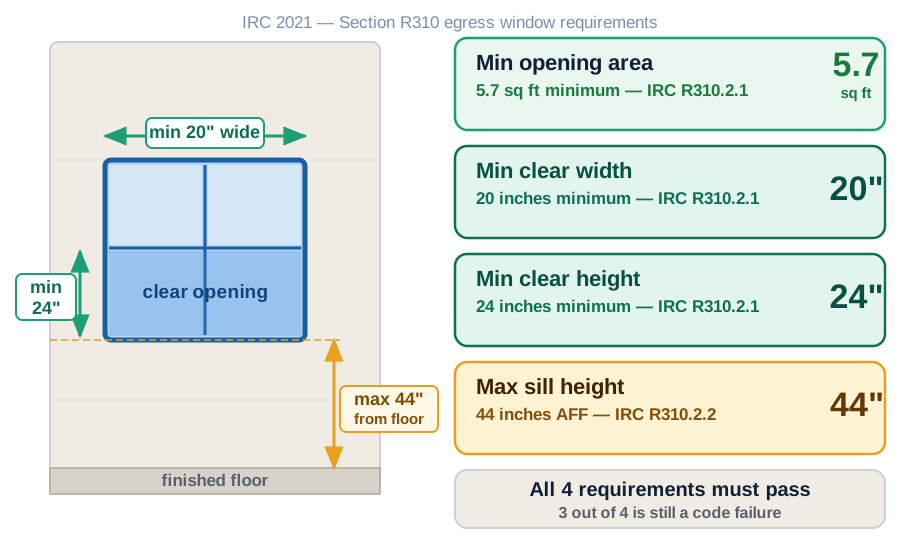
Every bedroom and basement sleeping room in a residential home must have at least one egress window — a window large enough to escape through in an emergency. The rules come from Section R310 of the International Residential Code (IRC), and they are non-negotiable: fail inspection, and the room cannot legally be classified as a bedroom.
This guide breaks down every requirement in plain English, with the exact numbers you need.
Check your window in 30 seconds
Enter your window dimensions and get an instant pass/fail result against IRC R310.
Use the free egress calculator →What is an egress window?
An egress window is a window that is large enough and low enough to the floor that an adult can climb through it during an emergency — a fire, gas leak, or flood. The word "egress" simply means exit. Building codes require these windows in all sleeping rooms because people in those rooms may be asleep and unable to reach a door.
Egress windows are not just about escaping. They also allow firefighters to enter a room to rescue occupants who are trapped or unconscious. This is why the size and height requirements exist — they are sized around a person in full firefighting gear.
IRC R310: The four requirements
Under IRC 2021 Section R310, an egress window must meet all four of the following criteria simultaneously. Passing three out of four is still a failure.
| Requirement | Minimum / Maximum | IRC Reference |
|---|---|---|
| Net clear opening area | 5.7 sq ft minimum | R310.2.1 |
| Net clear opening width | 20 inches minimum | R310.2.1 |
| Net clear opening height | 24 inches minimum | R310.2.1 |
| Sill height above finished floor | 44 inches maximum | R310.2.2 |
How to calculate the opening area
Multiply the clear width (in inches) by the clear height (in inches), then divide by 144 to convert to square feet.
Example: A window with a 24-inch clear width and 36-inch clear height gives: (24 × 36) ÷ 144 = 6.0 sq ft — which passes the 5.7 sq ft minimum.
A window with a 20-inch clear width and 24-inch clear height gives: (20 × 24) ÷ 144 = 3.33 sq ft — which passes the width and height minimums individually, but fails the area requirement.
Sill height: the most commonly failed requirement
The sill height rule catches many homeowners off guard. IRC requires the window sill — the bottom of the window opening — to be no more than 44 inches above the finished floor. This ensures that an average adult can reach and climb through the window without needing furniture or a ladder.
In practice, this is most problematic in basements, where windows are positioned high on the wall to be above grade outside. Many existing basement windows sit 50–60 inches AFF (above finished floor), which fails the code requirement for a sleeping room.
Bedroom vs. basement rules
The same four requirements apply to both above-grade bedrooms and basement sleeping rooms. There is no separate "basement egress standard" in IRC 2021 — R310 covers both equally.
However, basements present unique challenges:
- Sill height: Basement windows are often high on the wall, making the 44-inch maximum difficult to meet without repositioning the window
- Window wells: If the window is below grade, a window well must be installed to allow egress. Window wells deeper than 44 inches must have a built-in ladder or steps
- Soil and foundation work: Lowering or enlarging a basement window often requires cutting through the foundation wall, which adds significant cost
Which rooms require egress windows?
Under IRC R310.1, the following spaces require at least one egress window:
- Every sleeping room (bedroom)
- Every basement used as a sleeping room
The following spaces do not require egress windows under IRC:
- Living rooms, dining rooms, kitchens, bathrooms
- Unfinished basements used only for storage or mechanical equipment
- Garages
Window types and egress compliance
Not all window types are equally suited to egress. Here is how common types perform:
| Window type | Egress suitability | Notes |
|---|---|---|
| Casement (crank-out) | Excellent | Opens fully — entire frame area counts as opening |
| Double-hung (slide up) | Limited | Only the bottom half opens — reduces effective opening area by 50% |
| Single-hung | Limited | Same as double-hung — only one sash opens |
| Slider (horizontal) | Moderate | Only one panel slides — 50% of frame area is usable |
| Awning (hinged top) | Poor | Restricted opening angle — rarely meets height minimum |
| Hopper (hinged bottom) | Poor | Opens inward — reduces usable clear area significantly |
| Fixed / picture | Fails | Does not open — cannot be used as egress |
For basement egress specifically, casement windows installed in a window well are the most common and practical solution. They open fully and allow the entire frame dimension to count toward your clear opening area.
Window well requirements
When a basement egress window is installed below grade, IRC R310.2.3 requires a window well. The window well must:
- Allow the window to open fully
- Have a minimum horizontal area of 9 square feet
- Have a minimum horizontal projection and width of 36 inches
- Include an escape ladder or steps if the well is deeper than 44 inches