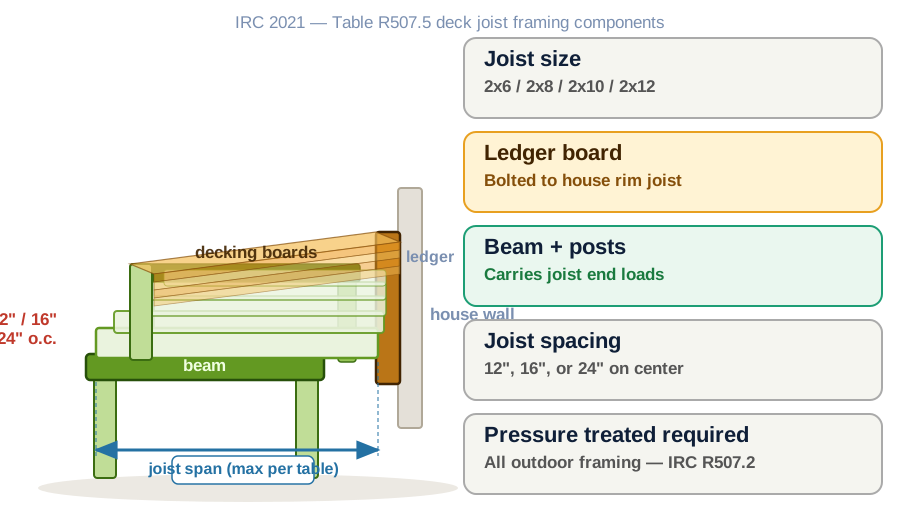
Choosing the right deck joist size is one of the most critical structural decisions in deck construction. Undersized joists will sag, bounce, and eventually fail. Oversized joists waste money. The correct size depends on three variables: your lumber species, joist size, and spacing between joists.
The tables below come directly from IRC 2021 Table R507.5, which covers residential deck joists under a standard 40 psf live load and 10 psf dead load.
Check your specific joist setup instantly
Select your species, size, spacing, and span length for a pass/fail result with margin and utilization.
Use the free span calculator →Douglas Fir-Larch — maximum deck joist spans
Douglas Fir-Larch (DF-L) is the most widely available framing lumber in the western United States and one of the strongest species in common use. No. 2 grade is the standard for deck framing.
| Joist size | 12" o.c. | 16" o.c. | 24" o.c. |
|---|---|---|---|
| 2×6 | 9'–6" | 8'–8" | 7'–6" |
| 2×8 | 12'–6" | 11'–4" | 9'–10" |
| 2×10 | 16'–0" | 14'–6" | 12'–8" |
| 2×12 | 19'–6" | 17'–6" | 15'–4" |
Southern Yellow Pine — maximum deck joist spans
Southern Yellow Pine (SYP) is the dominant framing lumber in the southeastern and south-central United States. It is denser and stronger than Douglas Fir in most grades, producing slightly longer allowable spans.
| Joist size | 12" o.c. | 16" o.c. | 24" o.c. |
|---|---|---|---|
| 2×6 | 9'–10" | 8'–11" | 7'–9" |
| 2×8 | 12'–11" | 11'–9" | 10'–3" |
| 2×10 | 16'–6" | 15'–0" | 13'–1" |
| 2×12 | 20'–1" | 18'–2" | 15'–10" |
Hem-Fir — maximum deck joist spans
Hem-Fir is common throughout the Pacific Northwest and is somewhat weaker than Douglas Fir. It is frequently available as pressure-treated lumber in western states.
| Joist size | 12" o.c. | 16" o.c. | 24" o.c. |
|---|---|---|---|
| 2×6 | 8'–10" | 8'–0" | 7'–0" |
| 2×8 | 11'–8" | 10'–7" | 9'–3" |
| 2×10 | 14'–11" | 13'–7" | 11'–9" |
| 2×12 | 18'–2" | 16'–5" | 14'–3" |
Spruce-Pine-Fir — maximum deck joist spans
Spruce-Pine-Fir (SPF) is the most common species group in Canada and the northeastern United States. It has slightly lower strength values than Douglas Fir or Southern Yellow Pine, so spans are more conservative.
| Joist size | 12" o.c. | 16" o.c. | 24" o.c. |
|---|---|---|---|
| 2×6 | 8'–8" | 7'–10" | 6'–10" |
| 2×8 | 11'–5" | 10'–4" | 9'–0" |
| 2×10 | 14'–7" | 13'–3" | 11'–6" |
| 2×12 | 17'–9" | 16'–1" | 14'–0" |
How to read these tables
The spans shown are the maximum center-to-center distance between beam supports under standard residential loading (40 psf live + 10 psf dead load). Here is how to apply them:
- Identify your lumber species (check the stamp on the wood or ask your supplier)
- Choose your joist size — start with 2×8 for most decks, increase if your span exceeds the maximum
- Determine your joist spacing — 16" o.c. is standard; tighten to 12" for composite decking or heavy loads
- Measure or plan your span — the distance between beam centerlines (or between beam and ledger)
- Cross-reference your span against the table for your species and spacing
Joist spacing: 12, 16, or 24 inches?
16 inches on center is the most common spacing for residential decks. It works well with standard 5/4 deck boards and pressure-treated 2× lumber, and it offers a good balance between structural capacity and material cost.
12 inches on center is used when the decking material requires tighter support (some composite decking brands specify 12"), when adding a hot tub, or when the required span exceeds what 16" spacing allows with the available lumber size.
24 inches on center reduces lumber cost but significantly reduces the maximum allowable span. It is less common for decks and is generally only used with engineered lumber or in low-load applications. Always check your decking manufacturer's requirements — many composite products do not allow 24" joist spacing.
When to go up a joist size
If your deck span exceeds the maximum for your current species and spacing, you have three options:
- Upsize the joist — go from 2×8 to 2×10, or 2×10 to 2×12
- Tighten the spacing — go from 16" to 12" on center
- Add a mid-span beam — split the span in half by adding a beam and post in the middle
Adding a mid-span beam is often the most cost-effective solution for long spans, since it halves the required joist span without requiring larger lumber across the whole deck.
Pressure treatment requirements
IRC R507.2 requires all deck joists to be either pressure-treated lumber, naturally durable wood (redwood, cedar, black locust), or protected from moisture. In practice, pressure-treated Southern Yellow Pine or Hem-Fir is used on virtually all residential decks.
Treatment levels matter: above-grade deck framing typically requires UC3B treatment (0.15 pcf). Joists in contact with the ground or embedded in concrete require UC4A or UC4B (0.40 pcf). Always confirm the treatment level on the lumber stamp.